


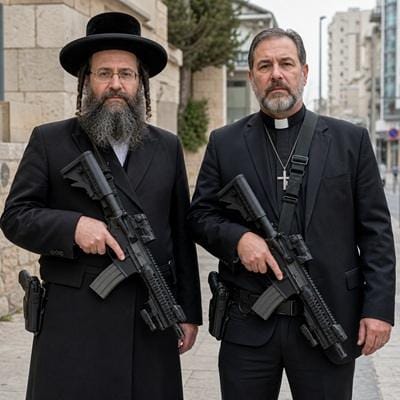
“Live by the sword, die by the sword” is what hostile enemies must face next time they target houses of worship. They could very well die by the sword if they mess with God’s people!
Across the United States, synagogues and churches are equipping congregants with practical self-defense and emergency preparation skills as threats to houses of worship intensify. Rising antisemitic incidents and attacks on religious sites have shifted traditional reliance on hired guards or delayed police response toward layered, community-driven security in which members themselves play active roles.
Physical assaults against Jews reached a 46-year high in 2025, with Secure Community Network (SCN) logging a record 5,409 threat and suspicious activity reports in 2024—112 percent higher than two years earlier. High-profile episodes, including stabbings and vehicle ramming attempts at Jewish facilities, have accelerated the change.
Synagogues and Churches are responding by training ordinary members as volunteer security teams rather than depending solely on commercial guards or emergency services.
The Community Security Service (CSS), founded by New York Jewish community members in 2007 and expanded after the 2018 Tree of Life massacre, has trained more than 20,000 people and maintains over 7,100 active volunteers who protect more than 500 synagogues and events weekly. Training covers surveillance, questioning, intelligence gathering, decision-making under pressure, security planning, and Krav Maga.
Volunteers learn to recognize what looks out of place in their own communities—knowledge professional guards often lack—and practice rapid response scenarios at actual synagogues.
SCN, the official security organization for North American Jewish communities, conducts facility assessments, helps secure millions in grant funding, and promotes emergency operations plans. Recommended steps include forming security committees, hardening doors and entry points, installing cameras, controlling access, and repeatedly training staff and volunteers in situational awareness, de-escalation, lockdown procedures, and medical response such as Stop the Bleed. Groups stress that security is “a team sport.” Retired FBI agent Rusty Rosenthal of JShield in the Washington area notes that every person can contribute without becoming law enforcement.
Rabbis, including Nolan Lebovitz of Valley Beth Shalom in Los Angeles, work to preserve spiritual openness and welcome while assuring families that every available tool is in use.
Churches face parallel pressures and are adopting comparable measures. Joint safety summits for churches, synagogues, and schools teach Run-Hide-Fight protocols, lockdown drills, first-aid readiness, and coordination with the FBI, CISA, and local law enforcement.
Programs such as those offered by former SWAT officers evaluate building layouts, recommend physical upgrades, and run scenario-based drills so volunteer teams can act in the critical minutes before police arrive. Many congregations pursue FEMA Nonprofit Security Grants for cameras, reinforced entrances, and training while developing written emergency action plans. Some church networks also incorporate basic firearms instruction under strict legal and safety guidelines, always paired with judgment training and emphasis on de-escalation.
Don’t mess with God’s people, or the criminal could die by the sword!