




More than sixteen centuries after his death, St. Augustine of Hippo has spoken again. Two previously unknown sermons by one of Christianity’s most influential Church Fathers have been authenticated, offering fresh insight into the mind of a theologian whose writings still shape Christian thought.
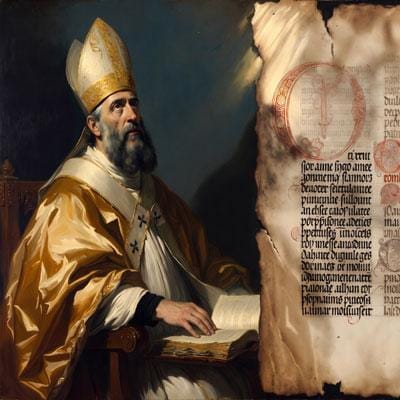
The sermons were identified by Christian Tornau, a Latin professor at the University of Würzburg in Germany. They appear in a twelfth-century manuscript originally copied at Bad Doberan Abbey in northern Germany and now preserved in the Diocesan Library of Pelplin, Poland. In 2024 a representative of the monastery’s preservation association asked Tornau to examine the codex. Of the six sermons it contains, two had never been known to modern scholarship.
Augustine lived from 354 to 430 and served as bishop of Hippo Regius in what is now Algeria. His vast body of work—Confessions, City of God, and hundreds of sermons—continues to occupy scholars. These newly recovered texts address one of the Old Testament’s most unsettling episodes: King Saul’s consultation with the Witch of Endor, recorded in 1 Samuel 28.
Desperate before a decisive battle with the Philistines and receiving no answer from God, Saul seeks out a medium. At his request she summons what appears to be the spirit of the dead prophet Samuel. The apparition foretells Saul’s defeat and death, raising profound questions of theodicy—why an all-powerful God would permit such an apparently diabolical act.
In the first sermon, preached on a Sunday, Augustine presents the problem and possible interpretations. In the second, delivered the following Wednesday, he weighs the alternatives more carefully. The most striking element, Tornau notes, is Augustine’s suggestion that Saul may have repented upon hearing Samuel’s prophecy and ultimately found redemption.
This view is virtually without parallel in Augustine’s known works or in ancient Christianity generally, both of which tend to portray Saul in strongly negative terms. “This is unparalleled in Augustine and in ancient Christianity in general,” Tornau has said. The bishop of Hippo appears willing to take seriously the possibility that even a figure as compromised as Saul remained capable of salvation through the grace of God.
Tornau and other scholars spent nearly two years examining the texts. They concluded that the sermons reflect the liturgical style of late-antique North Africa, display Augustine’s characteristic humor and independence of mind, and show familiarity with his thought without simply copying earlier works. “Our final verdict is that they are indeed authentic,” Tornau stated.
The manuscript cannot be traced earlier than the twelfth century, but the sermons themselves belong firmly to Late Antiquity. Tornau is now preparing the first scholarly edition for publication.