





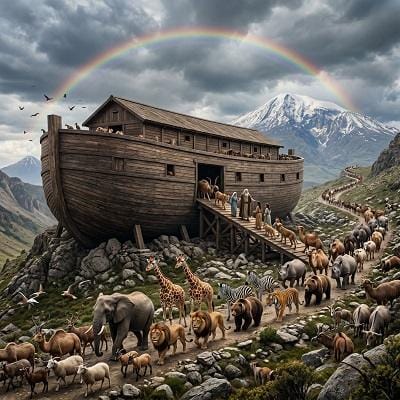
The ark deniers, bible skeptics and confused historians rebut the ark discover as simple a meaningless pile of dirt but research is showing different.
In the rugged mountains of eastern Turkey, near the legendary Mount Ararat, a boat-shaped formation known as the Durupinar site continues to ignite one of history’s most enduring controversies. Recent scientific findings have added fresh fuel to claims that this could be the resting place of Noah’s Ark, as described in the Book of Genesis.
Yet, despite compelling new data, many mainstream experts remain hesitant to embrace what believers see as powerful corroboration of the biblical account.
The Durupinar formation, first spotted in 1959 by Turkish Captain İlhan Durupinar, measures approximately 515 feet (157 meters) in length—remarkably aligning with the biblical dimensions of Noah’s Ark, which Genesis 6:15 describes as 300 cubits long (roughly 450-510 feet depending on the cubit standard). Located about 15-18 miles from the summit of Mount Ararat in the Doğubayazıt region, the site has drawn researchers for decades.
Proponents, including Andrew Jones of Noah’s Ark Scans, argue it is not merely a geological oddity but the decayed remains of a massive, man-made vessel.
New soil analysis conducted in 2024 and highlighted in 2026 provides some of the strongest evidence yet. Researchers collected samples from inside and outside the formation. Results showed nearly three times more organic matter inside the boat-shaped structure compared to surrounding soil. Potassium levels were 38% higher inside, consistent with wood ash, while pH differences were dramatic—eight times greater—suggesting a “closed system” where biological materials, possibly wood, resin, or even animal remains, decayed over millennia and altered the soil chemistry.
Ground-penetrating radar (GPR) and electrical resistivity tomography (ERT) scans from 2019 onward have revealed subsurface anomalies: linear corridors, right-angled structures, and what appear to be layered chambers or tunnels about four meters down and two meters high, running along the center and edges. These features, proponents say, mimic the multi-deck design of a large ship rather than random natural folds. Jones has emphasized that such internal complexity is “difficult to attribute to natural geological processes.” The team is now calling for core drilling and advanced 3D mapping by Turkish scientists to investigate further.
This isn’t the first time the site has sparked excitement. Earlier claims by explorer Ron Wyatt in the 1970s and 1980s popularized the location, though they faced significant pushback. A 1996 peer-reviewed paper in the Journal of Geoscience Education by geologists Lorence G. Collins and David Fasold concluded the formation was a natural rock structure—a syncline or eroded geological feature common in the region. Skeptics point to similar boat-like formations nearby and argue that the “ark” lacks definitive artifacts like ancient timber or metal fastenings.
Critics, including some Christian geographers and organizations like Answers in Genesis, urge caution. They note that while the Bible places the Ark “on the mountains of Ararat” (a regional reference, not necessarily the peak), extraordinary claims require extraordinary evidence. Turkish academics, such as Professor Faruk Kaya, have described some associated finds (like pottery) as preliminary and insufficient for confirmation. Mainstream archaeology often views Ark hunts as bordering on pseudoscience, preferring peer-reviewed publication over media announcements.
Yet, for many, the convergence of factors—precise dimensions, location in the Ararat region, chemical anomalies, and subsurface structures—feels too coincidental to dismiss outright. The biblical Flood narrative, shared in various ancient cultures (including the Epic of Gilgamesh), describes a cataclysmic event that could align with post-Ice Age flooding theories. If verified, the discovery would not only affirm scriptural historicity but reshape understandings of ancient engineering, human origins, and global catastrophe.
The reluctance of some experts to fully investigate or acknowledge these findings raises questions about potential biases. In an era where science and faith are often pitted against each other, does institutional skepticism sometimes overshadow open inquiry? Jones and his collaborators believe the data demands more rigorous testing, not dismissal. As calls for deeper excavation grow, the Durupinar site stands as a modern Mount Ararat of debate—one that could either vindicate an ancient account or remain a fascinating geological puzzle.
Believers worldwide, these findings offer renewed hope that the Bible’s “oldest debate” may yet prove profoundly right.