




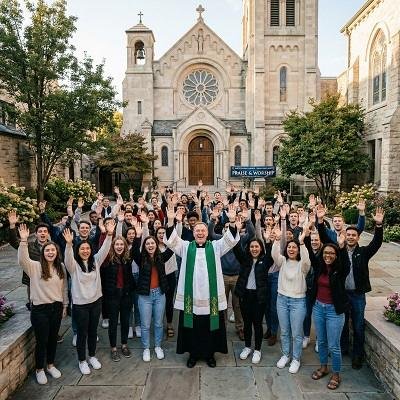
The surge in Catholic conversions in a secular age is astounding. In an era defined by digital distraction, political polarization, and widespread religious disaffiliation, a quiet counter-trend is gaining momentum: young adults are flocking to the Catholic Church.
Across the United States, dioceses report record numbers of adult converts—many in their 20s—preparing for baptism or full communion at Easter. This resurgence, church leaders say, reflects a deep hunger for truth, stability, and transcendence in a world many describe as “bleakly secularized.”
The numbers tell a striking story. The Archdiocese of Newark, New Jersey, is guiding 1,701 individuals through the Rite of Christian Initiation of Adults (RCIA)—a 30 percent jump from 2025. Similar growth appears in Cleveland, Boston, Portland, and Los Angeles, where officials expect 8,598 new Catholics this Easter, up sharply from prior years. On college campuses, the trend is even more pronounced. Notre Dame anticipates 163 candidates and catechumens, the largest group in at least 25 years. Arizona State University’s Newman Center received 52 students last fall and projects another 50 this spring—far exceeding pre-pandemic records. Texas A&M and other Catholic campus ministries echo the same pattern.
Bishop Robert Barron, founder of Word on Fire Ministries, has watched this shift firsthand. “Younger generations have inherited this bleakly secularized world,” he told Fox News Digital, “and they are leading the charge back to faith.” When he asks new converts why they chose Catholicism, the most common answer is simple: “I was hungry for truth.” Many describe growing up amid the “New Atheism” of the early 2000s, only to find that material success, social media validation, and endless entertainment left them restless. St. Augustine’s ancient insight resonates powerfully today: “You have made us for yourself, O Lord, and our heart is restless until it rests in you.”
What draws them is Catholicism’s ancient depth in a culture that feels ephemeral. “Our culture today is very evanescent,” Barron notes. “Catholicism speaks to something much deeper, older, and more permanent.”
Young adults speak of being captivated by the Church’s liturgy—the incense, Gregorian chant, vestments, and solemn rituals that stand in stark contrast to sterile Zoom gatherings or pop-concert worship services. In a world of constant change and algorithmic distraction, the 2,000-year-old tradition offers roots.
Online evangelists like Barron, Scott Hahn, and Father Mike Schmitz have amplified this appeal, presenting intellectually robust answers to modern questions without watering down doctrine.
The scandals that rocked the Church two decades ago loom less large for this cohort. Many converts view the sexual-abuse crisis as historical rather than immediate. What matters more is the Church’s unapologetic stance on objective truth amid cultural relativism. Pew Research Center’s 2025 data shows that while 92 percent of U.S. Catholics were raised in the faith, the 8 percent who converted often cite alignment with their values or a sense that “it just made sense.” Some come through marriage, but many arrive through personal search.
Broader data suggests this is part of a subtle Gen Z shift. Barna Group research finds young adults now leading older generations in monthly church attendance. The SEEK 2026 conference drew more than 26,000 Catholic young people eager for vibrant faith. Harvard’s ongoing election study noted Gen Z Catholic identification rising from 15 percent in 2022 to 21 percent in 2023. Yet Pew cautions that overall religious “nones” remain high, and net losses from Catholicism still outpace gains nationally. The campus and diocesan surges, however, point to genuine pockets of revival.
Retention remains the Church’s next challenge. Barron emphasizes listening: “First you listen and find out what’s attracted them.” Evangelization, he insists, is the Church’s core mission—to invite people to Christ. For a generation raised on skepticism, the return to faith signals not nostalgia but a forward-looking quest for meaning.
In rejecting the emptiness of pure secularism, these young adults are proving that the human heart still yearns for something eternal. Their conversions may be small in the national picture, but they signal a profound cultural pivot: in the restlessness of the 21st century, many are finding that only God satisfies. The Church, it seems, is ready to welcome them home.