





Christian Parental Rights Under Siege
The State grabbed their children because the family went to church 3 times per week.

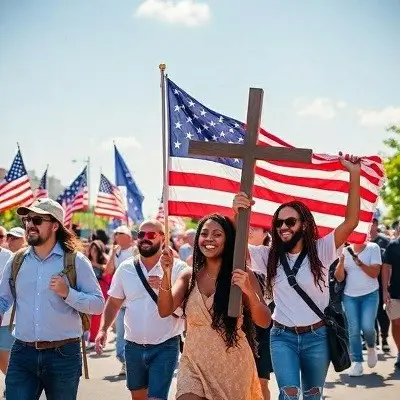
America is not moving left or right but moving up. Up in the sense that the American people are looking upward to the heavens for guidance and faith.
In an era where faith and politics increasingly intersect, a growing movement is reshaping the American landscape. Christian patriotism, often romanticized as the fusion of God and country into a singular ‘God’s Country,’ is gaining traction among a significant portion of the population. According to a recent study by the Public Religion Research Institute (PRRI), one-third of Americans now identify as adherents or sympathizers of this ideology. This trend highlights a deepening divide, where religious beliefs are not just personal but are wielded as tools to redefine national identity.
At its core, Christian patriotism is defined by organizations like Christians Against Christian Patriotism as a political ideology that merges Christian and American identities. Critics argue it distorts the essence of the Christian faith while undermining the principles of America’s constitutional democracy. The PRRI study, which surveyed attitudes through a series of five questions on the interplay between Christianity, American identity, and government, reveals that this mindset isn’t fringe—it’s mainstream for many. While two-thirds of Americans remain skeptics or outright rejecters, the stability of these figures since 2022 suggests a persistent undercurrent rather than a fleeting phenomenon. Notably, the percentage of rejecters dipped from a high of 32% in mid-2023 to 26% by late 2025, indicating a subtle shift toward greater acceptance or ambivalence.
Demographically, the movement’s stronghold lies within specific religious and ethnic groups. White evangelical Protestants lead the pack, with 67% embracing Christian patriotic views, followed by Hispanic Protestants at 54%. These are the only major religious demographics where a majority holds such beliefs. The data also uncovers racial disparities: White Americans who regularly attend services, pray, or engage with religious texts are far more likely to align with Christian patriotism than their Black or Hispanic counterparts. This pattern underscores how cultural and historical contexts influence the interpretation of faith in a nationalistic framework.
Political affiliations play a pivotal role in this rise. A majority of Republicans—56% in total—qualify as adherents (21%) or sympathizers (35%), dwarfing the figures for independents (around 25%) and Democrats (fewer than 20%). Media consumption further amplifies these divides: Two-thirds of those who rely on far-right news sources fall into the adherent or sympathizer categories, with 34% as full adherents. This correlation points to an echo chamber effect, where narratives blending divine providence with American exceptionalism thrive unchecked.
Socioeconomic factors add another layer. Support for Christian patriotism is stronger among those with lower education levels and in older age groups, suggesting it resonates with communities feeling economic or cultural displacement. Geographically, the ideology flourishes in the heartland. States like Arkansas (54%), Mississippi (52%), West Virginia (51%), Oklahoma (49%), and Wyoming (46%) boast the highest levels of support. In these areas, particularly among White, non-Hispanic residents—where figures climb to 59% in Arkansas, 54% in Mississippi, and 53% in West Virginia—the vision of ‘God’s Country’ feels less like metaphor and more like manifesto.
The implications extend beyond personal beliefs into the political arena. PRRI’s analysis shows a clear link: States with higher Christian patriotism scores are more inclined to view former President Donald Trump favorably and support Republican-led state legislatures. This fusion of faith and partisanship could influence elections, policy-making, and even cultural norms, potentially prioritizing religious litmus tests over democratic pluralism.
As America grapples with this rise, the question remains: Can the nation balance its diverse spiritual heritage with its foundational separation of church and state? For now, Christian patriotism’s ascent signals a cultural shift, where ‘God’s Country’ isn’t just a song lyric or a bumper sticker—it’s a rallying cry for millions seeking to sanctify the stars and stripes. Whether this movement strengthens national unity or deepens divisions will depend on how the remaining two-thirds respond.
The State grabbed their children because the family went to church 3 times per week.

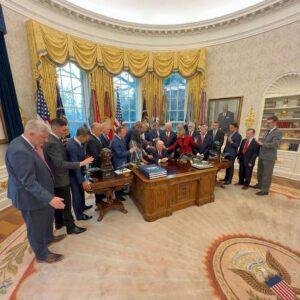
“We are honored to come before your presence today, lifting up our president.