




Christian Parental Rights Under Siege
The State grabbed their children because the family went to church 3 times per week.

Archaeology and ancient writings confirm Jesus performed miracles; some can’t explain how he did them, but none refute that they were miracles by the hand of Jesus.
In an era where skepticism often dominates discussions about faith, fresh scholarly insights are shedding light on the historical reality of Jesus’s miracles. Far from relying solely on the Bible, researchers are uncovering compelling extra-biblical sources that affirm these extraordinary events. This growing body of evidence, drawn from ancient non-Christian writers, challenges doubters and bolsters the case for Jesus’s supernatural acts as undeniable historical facts.
At the heart of this development is a nuanced understanding of ancient terminology and the testimony of figures like the Jewish historian Flavius Josephus, whose writings provide a window into first-century perceptions of Jesus.
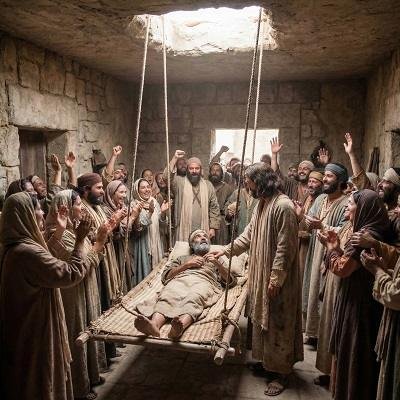
Consider the Gospel of Luke, chapter 5, where Jesus heals a paralyzed man lowered through a roof amid a throng of listeners. After forgiving the man’s sins—an act that sparks accusations of blasphemy—Jesus restores his mobility. The crowd’s reaction is one of profound astonishment: they glorify God and declare they’ve witnessed “paradoxa.” This Greek word, appearing only here in the New Testament, has puzzled translators. Some render it as “extraordinary” or “remarkable,” while others opt for “strange things.”
Ancient Greek dictionaries highlight their dual nature: they convey something bewildering, supernatural, and potentially paradoxical—neither purely positive nor negative, but evoking a sense of the uncanny, like a paranormal phenomenon.
This ambiguity mirrors broader ancient debates about Jesus’s powers. It wasn’t just believers who grappled with these events; critics did too. The Jewish Talmud accuses Jesus of “sorcery,” implying dark magic.
The Toledot Yeshu, a polemical Jewish text from the early centuries, spins absurd tales of Jesus stealing divine names to perform resurrections. Pagan voices chime in similarly. The second-century philosopher Celsus, a fierce opponent of Christianity, uses the very term “paradoxa” to describe Jesus’s feats, attributing them to Egyptian sorcery rather than denying them outright.
Other pagans speculated he might be a minor deity or a trickster. What’s striking is the consensus: no one in antiquity outright rejected the occurrence of miracles. Instead, adversaries scrambled for alternative explanations, no matter how far-fetched.
This pattern underscores a key point—Jesus’s miracles were so well-attested that denial wasn’t an option.
Early Christians countered by highlighting the moral thrust of his acts: healing the sick, raising the dead, and preaching love and repentance. How could such benevolent deeds stem from evil forces? This rhetorical defense gains even more weight when we turn to Josephus, a first-century source whose proximity to the events makes his account invaluable.
Flavius Josephus, born in AD 37 to a priestly aristocratic family in Jerusalem, was no outsider. As a Pharisee, priest, and military leader, he rubbed shoulders with high priests, members of the Sanhedrin, and even Herod Agrippa II. Scholars argue he likely knew individuals present at Jesus’s trial. In his monumental work ‘Jewish Antiquities’ (18.63), Josephus refers to Jesus as a doer of “paradoxa.” Traditionally, this has been translated positively as “miraculous deeds,” leading some to suspect Christian interpolation—why would a Jewish historian praise Jesus so effusively?
Recent analysis, however, flips this narrative. By examining “paradoxa” in context, we see it’s not a glowing endorsement but a neutral, even skeptical descriptor. Josephus employs the term elsewhere to describe the feats of Pharaoh’s magicians in their contest with Moses, labeling them a “paradox” (singular)—supernatural yet possibly mere human trickery rather than divine. This parallel suggests Josephus viewed Jesus’s acts with similar caution: real, yes, but of uncertain origin.
Was it magic? Forbidden arts? He doesn’t affirm divinity, but crucially, he doesn’t debunk the events either.
Josephus’s reluctance to dismiss miracles aligns with his broader historiography. He mocked charlatans and false prophets in his writings and dismissed supernatural claims when they suited him, like spells aimed at him during his generalship. Yet for Jesus, he concedes that the deeds happened. Coming from a well-informed, non-Christian contemporary in Jerusalem, this is powerful extra-biblical corroboration. It adds to a mosaic of evidence from hostile sources, all of which admit the inexplicable while debating its source.
This mounting proof isn’t just academic trivia; it invites deeper reflection. Jesus’s miracles weren’t ends in themselves but signs pointing to his divine authority. In the paralyzed man’s story, physical healing validated spiritual forgiveness—a greater wonder. These acts authenticated his call to repentance and faith, offering eternal life. As extra-biblical confirmations grow, they challenge modern skeptics to reconsider: if ancient critics couldn’t deny the miracles, why should we?
The State grabbed their children because the family went to church 3 times per week.


“We are honored to come before your presence today, lifting up our president.